Garage Door Controller
This tutorial tests the state machine of a garage door opener: a button, a photo-eye and two limit switches in, a motor out. Event-driven logic like this is tested with a sequence: open the door, close it, block the photo-eye halfway, stop it, send it back. The tutorial builds on the two before it and covers:
- scheduling a test as steps and reusable input profiles, with checks in the steps and the number of the first failing step as the run's result;
- checking a state machine with a
Moderule (allowed transitions and dwell times), aResponserule (a deadline) and anAlwaysrule (a safety invariant); - naming the requirements a simulation verifies.
The controller

- A press of the wall button opens a closed door and closes an open one. A press while the door moves stops it, and the next press sends it back the way it came.
- A limit switch at each end stops the motor.
- If the photo-eye beam is interrupted while the door closes, the door goes back up. An open door doesn't close while the beam is blocked.
- The motor rests 0.5 s before it changes direction, in
REVERSINGafter an obstruction and inSTOPPEDafter a press. Reversing a motor under load at once stresses the gearbox and the motor drive. - A travel that takes longer than 15 s stops the motor: something is jammed.
These are the requirements, with the IDs the simulation reports:
| ID | Requirement | Rule |
|---|---|---|
| GD-1 | The door never runs down while the photo-eye is blocked. | never closes on an obstruction (Always) |
| GD-2 | An obstruction while closing sends the door back up within 1 s. | reopens within 1 s (Response) |
| GD-3 | The motor rests at least 0.5 s before it changes direction. | mode sequence (Mode) |
| GD-4 | No travel lasts longer than 15 s. | mode sequence (Mode) |
garageDoor.h
#pragma once
#include <stdint.h>

typedef enum
{
    DOOR_CLOSED = 0,
    DOOR_OPENING = 1,
    DOOR_OPEN = 2,
    DOOR_CLOSING = 3,
    DOOR_STOPPED = 4,
    DOOR_REVERSING = 5,
} DoorMode_te;

typedef struct GarageDoor_s
{
    /* Configuration */
    uint16_t reversePause_ms; /* the motor is off this long before it runs the other way */
    uint16_t maxRunTime_ms;   /* the longest a single travel may take */

    /* Inputs */
    uint8_t button;      /* wall button, 1 while pressed */
    uint8_t obstruction; /* photo-eye beam interrupted */
    uint8_t openLimit;   /* limit switch: door fully open */
    uint8_t closedLimit; /* limit switch: door fully closed */

    /* Outputs */
    int8_t motor; /* +1 up, -1 down, 0 off */
    DoorMode_te mode;

    /* State */
    uint8_t lastButton;
    int8_t lastDirection;
    uint16_t modeTime_ms;
} GarageDoor_ts;

void garageDoorInit(GarageDoor_ts *const ctx, uint16_t reversePause_ms, uint16_t maxRunTime_ms);
void garageDoorCyclic(GarageDoor_ts *const ctx, uint16_t cycle_ms);
garageDoor.c
#include "garageDoor.h"

static void enter(GarageDoor_ts *const ctx, DoorMode_te mode)
{
    ctx->mode = mode;
    ctx->modeTime_ms = 0;
    if (mode == DOOR_OPENING)
        ctx->lastDirection = 1;
    else if (mode == DOOR_CLOSING)
        ctx->lastDirection = -1;
}

void garageDoorInit(GarageDoor_ts *const ctx, uint16_t reversePause_ms, uint16_t maxRunTime_ms)
{
    ctx->reversePause_ms = reversePause_ms;
    ctx->maxRunTime_ms = maxRunTime_ms;
    ctx->button = 0;
    ctx->obstruction = 0;
    ctx->openLimit = 0;
    ctx->closedLimit = 1;
    ctx->motor = 0;
    ctx->lastButton = 0;
    ctx->lastDirection = -1;
    enter(ctx, DOOR_CLOSED);
}

void garageDoorCyclic(GarageDoor_ts *const ctx, uint16_t cycle_ms)
{
    uint8_t pressed = ctx->button && !ctx->lastButton;
    uint8_t timeout;

    ctx->lastButton = ctx->button;
    if (ctx->modeTime_ms < 60000)
        ctx->modeTime_ms += cycle_ms;
    timeout = ctx->modeTime_ms >= ctx->maxRunTime_ms;

    switch (ctx->mode)
    {
    case DOOR_CLOSED:
        if (pressed)
            enter(ctx, DOOR_OPENING);
        break;

    case DOOR_OPENING:
        if (ctx->openLimit)
            enter(ctx, DOOR_OPEN);
        else if (pressed || timeout)
            enter(ctx, DOOR_STOPPED);
        break;

    case DOOR_OPEN:
        if (pressed && !ctx->obstruction)
            enter(ctx, DOOR_CLOSING);
        break;

    case DOOR_CLOSING:
        if (ctx->obstruction)
            enter(ctx, DOOR_OPENING); /* something in the way: go back up */
        else if (ctx->closedLimit)
            enter(ctx, DOOR_CLOSED);
        else if (pressed || timeout)
            enter(ctx, DOOR_STOPPED);
        break;

    case DOOR_REVERSING:
        if (ctx->modeTime_ms >= ctx->reversePause_ms)
            enter(ctx, DOOR_OPENING);
        break;

    case DOOR_STOPPED:
        /* The next press runs the door the other way, once the motor has been off long enough */
        if (pressed && ctx->modeTime_ms >= ctx->reversePause_ms)
        {
            if (ctx->lastDirection > 0 && !ctx->obstruction)
                enter(ctx, DOOR_CLOSING);
            else if (ctx->lastDirection < 0)
                enter(ctx, DOOR_OPENING);
        }
        break;
    }

    ctx->motor = ctx->mode == DOOR_OPENING ? 1 : ctx->mode == DOOR_CLOSING ? -1 : 0;
}
The simulation

The door model is one line: the motor moves the door at 10 % of its travel per second between its end stops, and the limit switches report the ends.
The test is a list of steps. Each step is a function called every cycle for the step's duration. A stimulus step sets the button or the photo-eye. A check step returns whether the door is where it should be. A step with no function only waits. Pressing and releasing the button is an input profile of its own, press, written once and used throughout.
SimulateGarageDoor.c
#include <math.h>
#include <stdio.h>
#include <cppmodel/CModel.h>
#include "garageDoor.h"

#define DOOR_SPEED_PCT_PER_S 10.0 /* full travel in 10 s */

static GarageDoor_ts door;
static double position; /* plant: 0 % closed .. 100 % open */
static uint8_t button, obstruction;
static CppModelRule_t neverIntoObstruction, reopens, modeSequence;

/* ---- Stimuli and checks: each runs once per cycle for its duration, and returns whether the cycle passed ---- */

static uint8_t PressButton(CModelSimulation_ts *self, unsigned long t)
{
    (void)self, (void)t;
    button = 1;
    return 1;
}

static uint8_t BlockPhotoEye(CModelSimulation_ts *self, unsigned long t)
{
    (void)self, (void)t;
    obstruction = 1;
    return 1;
}

static uint8_t PressWhileBlocked(CModelSimulation_ts *self, unsigned long t)
{
    (void)self, (void)t;
    button = 1;
    obstruction = 1;
    return 1;
}

static uint8_t IsOpen(CModelSimulation_ts *self, unsigned long t)
{
    (void)self, (void)t;
    return door.mode == DOOR_OPEN && position >= 100.0;
}

static uint8_t IsClosed(CModelSimulation_ts *self, unsigned long t)
{
    (void)self, (void)t;
    return door.mode == DOOR_CLOSED && position <= 0.0;
}

static uint8_t IsStopped(CModelSimulation_ts *self, unsigned long t)
{
    (void)self, (void)t;
    return door.mode == DOOR_STOPPED && door.motor == 0;
}

/* Press and release the wall button: written once, used throughout */
static const CppModelStep_ts pressSteps[] = {
    CMODEL_STEP(PressButton, 200),
    CMODEL_STEP(NULL, 300),
};
static const CppModelInputProfile_ts press = CMODEL_INPUT_PROFILE(pressSteps);

static const CppModelStep_ts testSteps[] = {
    /* Open the door */
    CMODEL_STEP_INPUT_PROFILE(press),
    CMODEL_STEP(NULL, 11000),
    CMODEL_STEP(IsOpen, 0),
    /* Close it, and block the photo-eye halfway down: it must go back up */
    CMODEL_STEP_INPUT_PROFILE(press),
    CMODEL_STEP(NULL, 4000),
    CMODEL_STEP(BlockPhotoEye, 1000),
    CMODEL_STEP(NULL, 6000),
    CMODEL_STEP(IsOpen, 0),
    /* With the photo-eye blocked, a press doesn't close the door */
    CMODEL_STEP(PressWhileBlocked, 200),
    CMODEL_STEP(BlockPhotoEye, 2000),
    CMODEL_STEP(IsOpen, 0),
    /* Stop it halfway down, then send it back up */
    CMODEL_STEP_INPUT_PROFILE(press),
    CMODEL_STEP(NULL, 4000),
    CMODEL_STEP_INPUT_PROFILE(press),
    CMODEL_STEP(NULL, 2000),
    CMODEL_STEP(IsStopped, 0),
    CMODEL_STEP_INPUT_PROFILE(press),
    CMODEL_STEP(NULL, 6000),
    CMODEL_STEP(IsOpen, 0),
    /* Close it all the way */
    CMODEL_STEP_INPUT_PROFILE(press),
    CMODEL_STEP(NULL, 11000),
    CMODEL_STEP(IsClosed, 0),
};
static const CppModelInputProfile_ts test = CMODEL_INPUT_PROFILE(testSteps);

static void Init(CModelSimulation_ts *self, unsigned long stepTime_ms)
{
    (void)stepTime_ms;

    garageDoorInit(&door,
                   CppModel_getParameterU16(self, "ReversePause [ms]", 500),
                   CppModel_getParameterU16(self, "MaxRunTime [ms]", 15000));
    position = 0.0;

    /* GD-1: the door never runs down while the photo-eye is blocked */
    neverIntoObstruction = CppModel_ruleAlways(self, "never closes on an obstruction", 0.0);
    CppModel_ruleSignal(neverIntoObstruction, "Door.Motor [%]");

    /* GD-2: an obstruction while closing sends the door back up within 1 s */
    reopens = CppModel_ruleResponse(self, "reopens within 1 s", 1.0, 0.0);
    CppModel_ruleSignal(reopens, "Door.Motor [%]");

    /* GD-3: the motor rests 0.5 s before it changes direction; GD-4: no travel lasts longer than 15 s */
    modeSequence = CppModel_ruleMode(self, "mode sequence");
    CppModel_modeAllow(modeSequence, DOOR_CLOSED, DOOR_OPENING);
    CppModel_modeAllow(modeSequence, DOOR_OPENING, DOOR_OPEN);
    CppModel_modeAllow(modeSequence, DOOR_OPENING, DOOR_STOPPED);
    CppModel_modeAllow(modeSequence, DOOR_OPEN, DOOR_CLOSING);
    CppModel_modeAllow(modeSequence, DOOR_CLOSING, DOOR_CLOSED);
    CppModel_modeAllow(modeSequence, DOOR_CLOSING, DOOR_STOPPED);
    CppModel_modeAllow(modeSequence, DOOR_CLOSING, DOOR_REVERSING);
    CppModel_modeAllow(modeSequence, DOOR_REVERSING, DOOR_OPENING);
    CppModel_modeAllow(modeSequence, DOOR_STOPPED, DOOR_OPENING);
    CppModel_modeAllow(modeSequence, DOOR_STOPPED, DOOR_CLOSING);
    CppModel_modeDwell(modeSequence, DOOR_REVERSING, 0.5, NAN);
    CppModel_modeDwell(modeSequence, DOOR_STOPPED, 0.5, NAN);
    CppModel_modeDwell(modeSequence, DOOR_OPENING, NAN, 15.0);
    CppModel_modeDwell(modeSequence, DOOR_CLOSING, NAN, 15.0);
    CppModel_ruleSignal(modeSequence, "Door.Mode");

    CppModel_verifyRequirement(self, "GD-1");
    CppModel_verifyRequirement(self, "GD-2");
    CppModel_verifyRequirement(self, "GD-3");
    CppModel_verifyRequirement(self, "GD-4");
}

void RunCyclic(CModelSimulation_ts *self, unsigned long currentTime_ms)
{
    double dt_s = self->stepTime_ms / 1000.0;
    uint8_t passed, obstructedWhileClosing;

    /* The running step sets the stimuli and checks the door */
    button = 0;
    obstruction = 0;
    passed = CppModel_runInputProfile(self, &test, currentTime_ms);

    door.button = CppModel_getInputU8(self, "Button", button);
    door.obstruction = CppModel_getInputU8(self, "PhotoEye.Blocked", obstruction);
    door.openLimit = position >= 100.0;
    door.closedLimit = position <= 0.0;
    obstructedWhileClosing = door.obstruction && door.motor < 0;

    /* Controller under test */
    garageDoorCyclic(&door, (uint16_t)self->stepTime_ms);

    /* Plant model: the motor moves the door at constant speed between its end stops */
    position += door.motor * DOOR_SPEED_PCT_PER_S * dt_s;
    position = position < 0.0 ? 0.0 : position > 100.0 ? 100.0 : position;

    CppModel_setOutputF64(self, "Door.Position [%]", position);
    CppModel_setOutputI8(self, "Door.Motor [%]", (int8_t)(door.motor * 100));
    CppModel_setOutputI32(self, "Door.Mode", door.mode);

    CppModel_updateAlways(neverIntoObstruction,
                          CppModel_implies(CppModel_condition(door.obstruction), CppModel_condition(door.motor >= 0)));
    CppModel_updateResponse(reopens, obstructedWhileClosing, door.motor > 0);
    CppModel_updateMode(modeSequence, door.mode);

    CppModel_setOutputU8(self, "CppModel.StepResult", passed);
}

int main(void)
{
    CModelSimulation_ts *simulation = CppModel_create("GarageDoor", CppModel_inputProfileDuration(&test, 10), 10);
    if (simulation == NULL)
        return 1;

    CppModel_setInitFunction(simulation, Init);
    CppModel_setRunStepFunction(simulation, RunCyclic);
    CppModel_Simulate(simulation);

    int result = CppModel_getSimulationResult(simulation);
    CppModel_destroy(simulation);

    if (result != 0)
        printf("First failing step: %d\n", result);
    return result == 0 ? 0 : 1;
}
- Every cycle,
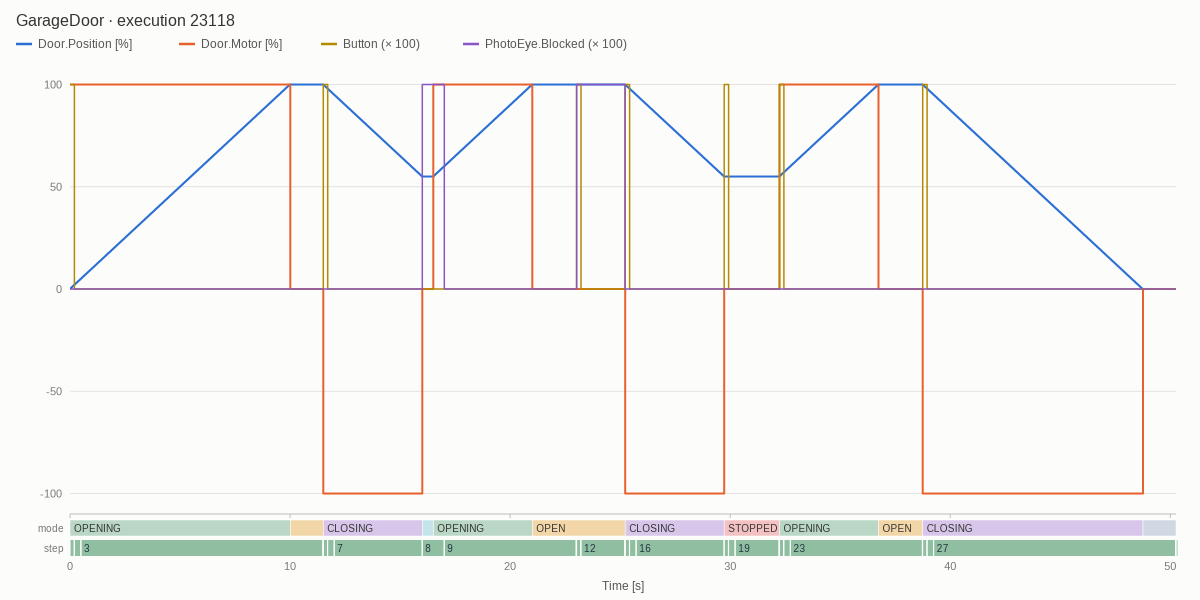
RunCyclic()clears the stimuli and letsCppModel_runInputProfile()run the current step, which sets them again. The library finds the step from the simulation time, so the steps need no state machine of their own. CppModel_inputProfileDuration(&test, 10)gives the length of the whole test, 50.26 s, to create the simulation with. Adding a step makes the run longer by itself.- The checks' results go into
CppModel.StepResult. The rules fail their steps by themselves. - The
Moderule lists every allowed transition. Any other change ofDoor.Modefails, and so does leavingREVERSINGorSTOPPEDbefore 0.5 s, or staying inOPENINGorCLOSINGfor more than 15 s. CppModel_verifyRequirement()inInit()records that the simulation verifies GD-1 to GD-4 for the whole run.
CMakeLists.txt
cmake_minimum_required(VERSION 3.21)

project(GarageDoor LANGUAGES C)

list(APPEND CMAKE_PREFIX_PATH "${CMAKE_SOURCE_DIR}/dependencies")
find_package(cppmodel REQUIRED)

enable_testing()

add_executable(SimulateGarageDoor garageDoor.c SimulateGarageDoor.c)
target_link_libraries(SimulateGarageDoor PRIVATE cppmodel::cppmodel)
cppmodel_deploy_runtime(SimulateGarageDoor)

add_test(NAME GarageDoor COMMAND SimulateGarageDoor)
cmake -S . -B build
cmake --build build
./build/SimulateGarageDoor
The CMake file assumes the CppModel library is extracted into a dependencies folder (see Installation).
Results
Every check passes. The door opens, goes back up when the photo-eye is blocked, stays open while it is blocked, stops and reverses, and closes. But a rule fails, and the program exits with 1:
CppModel.Verify.never closes on an obstruction: PASS held at 5027 checked step(s)
CppModel.Verify.reopens within 1 s: PASS 1 trigger(s) answered, slowest in 0 s (deadline 1 s)
CppModel.Verify.mode sequence: FAIL illegal transition 3 → 1 at t=16.01 s
CppModel.Verify: 2 of 3 rules passed
CppModel.Requirements: GD-1, GD-2, GD-3, GD-4
...
First failing step: 8
A failed run's result is the number of its first failing step, and main() prints it. Step 8 is BlockPhotoEye, so a CI log already says where to look, without opening the workspace. The exit code itself is only 0 or 1: exit codes keep 8 bits, so a failure at step 256 would otherwise exit with 0 and pass CI.
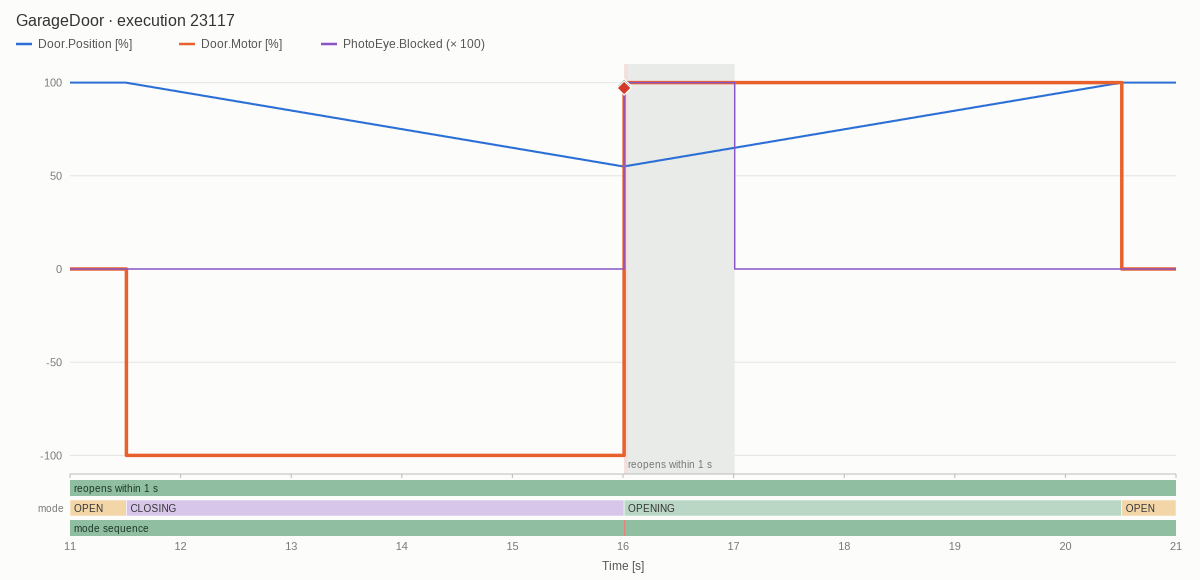
The mode strip under the graph shows the transition: CLOSING to OPENING in one 10 ms cycle, and the motor from full down to full up with it. The door does go back up, so a test that only checks that it reopens passes. reopens within 1 s passed too, with a response time of 0 s. But GD-3 requires a rest before the motor changes direction, and the Mode rule doesn't allow CLOSING to OPENING.
The bug is one line: the controller has a REVERSING state for exactly this case, and DOOR_CLOSING never enters it.
The fix
     case DOOR_CLOSING:
         if (ctx->obstruction)
-            enter(ctx, DOOR_OPENING); /* something in the way: go back up */
+            enter(ctx, DOOR_REVERSING); /* something in the way: stop, then go back up */
         else if (ctx->closedLimit)
             enter(ctx, DOOR_CLOSED);
         else if (pressed || timeout)
CppModel.Verify.never closes on an obstruction: PASS held at 5027 checked step(s)
CppModel.Verify.reopens within 1 s: PASS 1 trigger(s) answered, slowest in 0.5 s (deadline 1 s)
CppModel.Verify.mode sequence: PASS 11 transition(s), all allowed; lowest dwell margin 0 s
CppModel.Verify: 3 of 3 rules passed
CppModel.Requirements: GD-1, GD-2, GD-3, GD-4
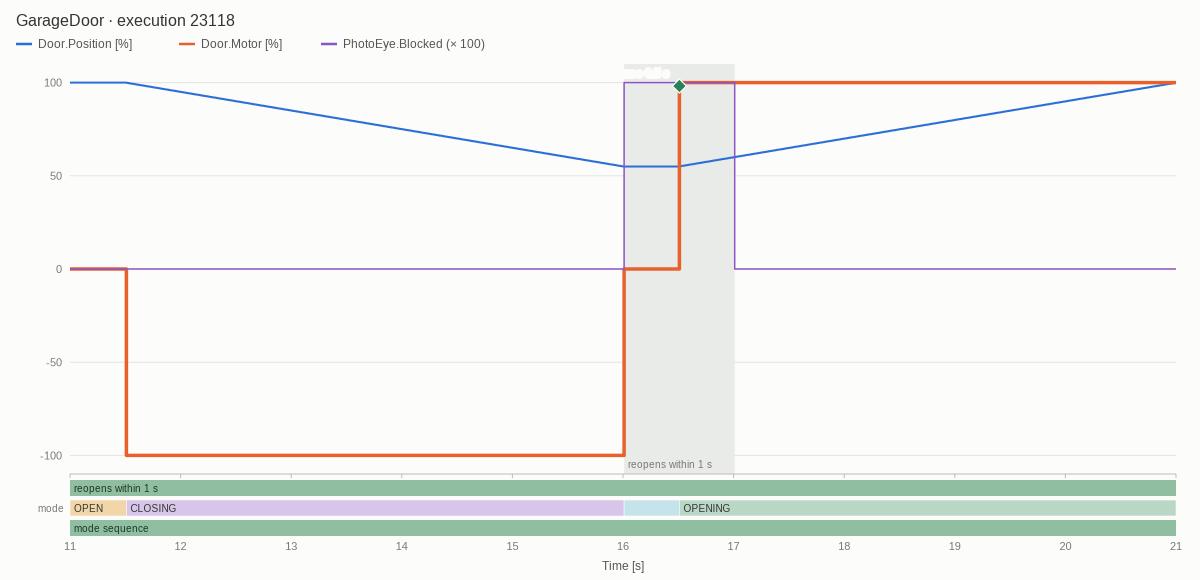
The motor now stops in the same cycle as the photo-eye is blocked, rests 0.5 s in REVERSING and then opens the door. The response arrives 0.5 s into the 1 s allowed. The whole test, with the step number of each part under the graph:
Reading the margins
lowest dwell margin 0 s means that the rest in REVERSING is exactly the 0.5 s GD-3 asks for, with nothing to spare. The run passes, but any shorter pause fails. Try it without rebuilding:
short-pause.json
{ "parameters": { "ReversePause [ms]": 300 } }
./build/SimulateGarageDoor --inputs short-pause.json
CppModel.Verify.mode sequence: FAIL left mode 5 after 0.3 s at t=16.31 s (min dwell 0.5 s)
A margin tells you how close a passing run came to failing, so you know which requirements a change of parameters or timing could break.
Requirement coverage
Every run writes the requirements it verified, and whether it passed, to cppmodel-requirements.json in the working directory:
{
  "GarageDoor": {
    "passed": true,
    "requirements": {
      "GD-1": { "from_s": null, "steps": 0, "to_s": null, "whole_run": true },
      "GD-2": { "from_s": null, "steps": 0, "to_s": null, "whole_run": true },
      ...
A CI job that runs all simulations can collect this file into a coverage report: which requirements are verified, by which simulation, and whether they passed. See Requirements.
Try it yourself
- Add a step that presses the button twice within 0.3 s while the door is moving. The second press must be ignored, and the
Moderule checks that the motor rests inSTOPPED. - Jam the door: make the model stop moving between 40 % and 50 % while the motor runs down. The 15 s run-time limit must stop the motor.
- Record GD-2 only while the door is closing with the photo-eye blocked, by calling
CppModel_verifyRequirement()inRunCyclic()at those steps instead of inInit(). The coverage file then shows when it was exercised.
More on the API: Steps and Input Profiles and Verification Rules.
Source code
The complete project, with short-pause.json, is on GitHub: Control-Edge/garage-door-controller, under the MIT license.